
Nakuru
One important thing that you need to know about Nakuru is that it lies in vicinity to the most prominent destinations of the world including Kenya’s capital Nairobi and Masai Mara. In addition to this, the attractive district is also home to the Menangai Crater which is the second largest volcanic crater of the world.
Bird watching
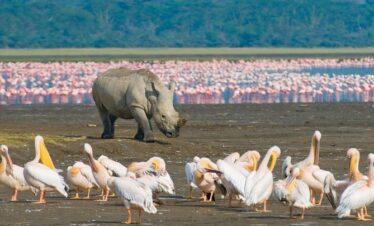
Bird watching in Kenya is a premier attraction for enthusiasts due to its diverse range of habitats and exceptional avian biodiversity. From the iconic Masai Mara, where species like the secretary bird and various vultures can be observed, to Lake Nakuru, renowned for its flamingo populations, Kenya offers a rich tapestry of bird-watching opportunities. The Kakamega Forest provides a glimpse into rare forest species such as the Great Blue Turaco, while the Aberdare National Park’s high-altitude environments reveal unique birds like the alpine chat. Tsavo National Park and the coastal regions of Diani Beach, Watamu, and Malindi offer varied ecosystems where one can spot species such as the Somali Ostrich and the Crab-plover. This diverse range of locations ensures that Kenya remains a top destination for bird watchers seeking to experience an array of bird species in their natural settings.
Jungle Safari
A is an overland journey, usually a trip by tourists to Africa. In the past, the trip was often a big-game hunt, but today, safari often refers to trips to observe and photograph wildlife—or hiking and sightseeing, as well.
The Swahili word safari means journey, originally from the Arabic meaning a journey; the verb for “to travel” in Swahili is kusafiri. These words are used for any type of journey, e.g. by bus from Nairobi to Mombasa or by ferry from Dar es Salaam to Unguja. Safari entered the English language at the end of the 1850s thanks to Richard Francis Burton, the famous explorer.
The Regimental March of the King’s African Rifles was ‘Funga Safari’, literally ‘tie up the March’, or, in other words, pack up equipment ready to march.
In 1836 William Cornwallis Harris led an expedition purely to observe and record wildlife and landscapes by the expedition’s members. Harris established the safari style of journey, starting with a not too strenuous rising at first light, an energetic day walking, an afternoon rest then concluding with a formal dinner and telling stories in the evening over drinks and tobacco.
Photography